Why Mobile Checkout Matters More for Bangladesh Shopify Stores (And How to Fix Yours)
In Bangladesh, most Shopify shoppers buy on a phone and pay cash on delivery. Here's why mobile checkout decides your conversion rate, and how to fix it.
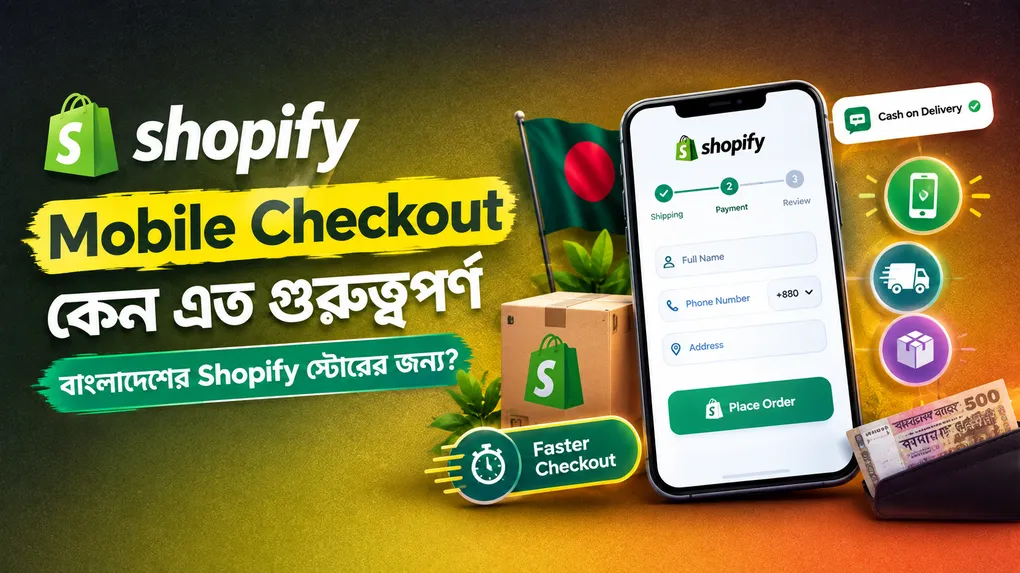
Picture a customer in Mirpur. It’s 11:40 at night, she’s lying in bed, and your Facebook ad shows up between two reels. She taps. The product page loads. She likes the kurti, likes the price, taps “Buy Now.”
Then Shopify checkout opens.
An email field she has to think about. A first name field, a last name field, address line 1, address line 2, city, a postal code she isn’t sure of, a country dropdown that already says Bangladesh but she scrolls it anyway to be safe. Shipping method selection. Then a payment step, where the only thing she actually wants is the option that says cash on delivery.
Somewhere in the middle of that, her thumb hits the back button.
You paid for that click. You will never know why you lost it. And if your store is like most Shopify stores selling in Bangladesh, this happens dozens of times a day.
This is why mobile checkout is not one optimization item on a long list for Bangladeshi merchants. It is the list.
Bangladesh isn’t “mobile-friendly.” Bangladesh is mobile-only.
Let’s start with numbers, because the gap between how merchants imagine their traffic and how it actually behaves is huge.
There were around 186 million active cellular connections in Bangladesh at the end of 2025, roughly 105 percent of the entire population, according to DataReportal’s Digital 2026 report. AMTOB’s own industry figures put mobile subscribers at about 187 million and internet subscribers at 131 million as of April 2026.
Here’s the part that matters more. Cloudflare Radar data from early 2026 put Bangladesh at the top of the world for mobile share of web traffic, at roughly 71 percent, more than 30 points ahead of the United States. Bangladesh didn’t go desktop, then laptop, then smartphone the way Europe did. For tens of millions of people here, the first device that ever loaded a web page was a phone. Most of them have never opened your store on anything else and never will.
Now stack the second fact on top. According to research cited by e-CAB and the International Trade Administration, more than 90 percent of Bangladeshi e-commerce users prefer cash on delivery. Not “sometimes use.” Prefer.
So the real profile of your buyer is this: a person on a mid-range Android phone, on mobile data, who wants to pay a delivery rider in cash tomorrow afternoon.
Shopify’s default checkout was not built for that person. It was built for someone at a desk with a saved credit card.
The specific problem: Shopify checkout is a card checkout wearing a COD costume
Shopify’s native checkout is genuinely excellent at what it was designed to do. Take a card payment from a returning customer with autofill. It handles that beautifully.
But run a COD store in Bangladesh and the same checkout starts working against you in five concrete ways.
1. It asks for an email first
By default, new Shopify stores are set to Email only as the customer contact method. You can change it under Settings, Checkout, Customer contact method, and switch to “Phone number or email.” Many merchants never do.
That single default is expensive here. A large share of Bangladeshi shoppers, especially outside Dhaka and Chattogram, don’t actively use email. Their digital identity is a phone number. It’s their bKash account, their Facebook login, their courier contact. Asking for email first is asking for the one piece of information they’re least sure about, at the exact moment their motivation peaks.
2. It’s a multi-page flow on a slow connection
Ookla’s Speedtest Global Index placed Bangladesh around 86th in the world for mobile internet speed in the September to November 2025 window, with a median mobile download speed near 41.72 Mbps and latency rising to about 25 ms. That headline number looks fine. Real-world experience does not match the median. Peak hours in dense Dhaka, a weak signal in a Sylhet village, a shared connection on a busy tower, and you’re looking at multiple seconds per page transition.
A three-page checkout on a slow connection isn’t three page loads. It’s three separate chances for someone to give up.
3. The address fields don’t match how Bangladeshis describe addresses
Shopify’s address form wants Address 1, Address 2, City, Postal code. Bangladeshi addresses are written as landmark descriptions. “House 14, Road 3, Block C, Bashundhara R/A, opposite Apollo gate.” There’s no clean split. The postal code field creates real hesitation, because most people don’t know their post code by heart and will either abandon or type something wrong, which turns into a failed delivery later.
4. Shipping cost shows up too late
Baymard Institute’s meta-analysis of 50 separate studies puts the average cart abandonment rate at 70.22 percent. When you strip out the people who were only browsing, the single biggest fixable reason is unexpected extra costs appearing at checkout, and roughly one in five abandoners point to a checkout that’s simply too long or complicated.
Bangladesh makes this worse, because shipping here is genuinely two-tier. Inside Dhaka city is one price. Outside Dhaka is another, usually double. If a customer sees 60 taka in their head and 130 taka at step three, you’ve broken trust at the worst possible moment.
5. You can’t see any of it happening
This one is quiet and expensive. Shopify’s checkout is a locked environment. Getting clean Meta Pixel, GA4, or TikTok events to fire reliably across it has been a recurring headache, and without accurate purchase events your ad platforms optimize against incomplete data. You end up scaling the wrong creative and killing the right one.
The result is the pattern almost every Bangladeshi Shopify merchant knows: strong ad engagement, decent add-to-cart numbers, then a cliff.
Baymard’s research also found that fixing documented checkout usability problems can lift conversion by as much as 35.26 percent. That’s not a rounding error. On a store doing 300 orders a month, that’s another 100 orders from traffic you already paid for.
What a mobile checkout for Bangladesh actually needs to look like
Forget “best practices” for a second and think about the physical reality. One thumb. A 6-inch screen. Patchy data. A customer who has been burned before by an online order that never arrived.
A checkout built for that person has seven properties.
It fits on one screen. No steps, no page transitions, no progress bar. The customer should be able to see the start and the end of the form in a single scroll.
It opens where they already are. The product page is where intent lives. Send them somewhere else and you lose a percentage at the door.
Phone number is the primary identity. Name, phone, address. Three fields. Everything else is optional or gone.
Shipping cost is visible before they commit. Show “Inside Dhaka 70, Outside Dhaka 130” as a selectable option inside the form, not as a surprise later.
Tap targets are big enough for a thumb. Small radio buttons and tight dropdowns are a desktop habit.
It speaks their language. Bangla labels convert better than English labels for a large share of the market, especially for older buyers and buyers outside the two big cities.
Every step is tracked. If you can’t see where people drop, you’re optimizing blind.
How Neo COD Form & Upsell handles the mobile side
This is exactly the problem Neo COD Form & Upsell was built to solve. It’s worth mentioning that the team behind it is based in Dhaka, which shows up in the feature set. A lot of decisions in the app only make sense if you’ve actually watched a Bangladeshi COD order fail.
Here’s what it changes on mobile, point by point.
The checkout becomes one form on the product page
Instead of pushing the customer into Shopify’s multi-step flow, the app puts a COD order form directly on the product page. You can run it as a pop-up that opens when the buy button is tapped, or embedded inline on the page. On a phone, the pop-up mode gives you the full-screen, focused experience that stops customers from getting distracted mid-order.
No page transitions. No email step. No hunting for the COD option. Tap, fill three fields, confirm.
One merchant review from a Bangladeshi drone accessories store on the Shopify App Store describes exactly this effect: their abandoned order rate dropped noticeably within two weeks, because customers could place a COD order without going through the long checkout.
You control every field, in the order that makes sense
The form builder is drag and drop, so you decide what the customer sees and in what order. Phone number first if you want. Postal code removed entirely if it’s causing more failed deliveries than it prevents. A custom field for “nearest landmark,” which is far more useful to a Pathao or Steadfast rider than a post code.
You can also set label position, colors, and border radius to match your theme, and preview it live. No theme code editing, no developer.
Shipping rates that match how Bangladesh actually ships
The app lets you create shipping rates and then limit each rate to specific provinces, states, or even specific cities. This maps cleanly onto the inside Dhaka versus outside Dhaka split every Bangladeshi merchant deals with. The customer picks their area inside the form and sees the delivery charge right there, before they confirm. No surprise at the end.
You can also apply rules per product, and set an additional COD fee if you charge one, transparently, in the same view.
OTP verification, because fake orders are a mobile problem too
Fake and mistaken orders are the tax every COD store pays. A customer taps twice. A competitor places a junk order. Someone enters a number with a missing digit. Then you pay outbound and return shipping on a parcel that generates nothing.
Neo COD can send an OTP to the customer’s phone by SMS or WhatsApp before the order is created. It takes fifteen seconds and it filters out a meaningful share of bad orders before you ever pack them. On top of that, the fraud controls let you block specific phone numbers, emails, or IPs, whitelist IPs, cap repeat orders per customer, and allow or block specific postal codes so you don’t accept orders from areas your courier can’t reach.
Upsells designed for thumbs, not mouse pointers
Raising average order value on mobile is a different craft. Nobody is reading a comparison grid on a phone at midnight.
The app gives you formats that work at that size: one-tick upsells (a single checkbox inside the form, “add a second one for 200 taka off”), quantity discounts shown as tappable tiers, pre-purchase and post-purchase upsells, and downsells for customers who decline the first offer. Each one is a single tap, which is the only interaction pattern that reliably converts on mobile.
There’s also partial payment, where you collect a deposit through bKash, Nagad, or a card before shipping. In a market where mobile financial services handle close to 24 million transactions a day and bKash alone has around 75 million registered customers, asking for a small advance is no longer the friction it was five years ago. It cuts your RTO exposure hard.
Pixel tracking that actually fires
Because the order happens inside the app’s own form rather than deep in Shopify’s checkout, event tracking gets much cleaner. Neo COD supports Meta Pixel with Conversions API, GA4, Google Ads, TikTok, Snapchat, Pinterest, and X, and you can run multiple pixels at once.
For a Bangladeshi store running Facebook and TikTok ads, this is not a nice-to-have. Server-side events through CAPI mean Meta’s algorithm learns from real purchases instead of a partial signal, and your cost per order comes down over time because the optimization is working from better data.
Abandoned carts recovered on the channel people actually check
Email recovery flows underperform badly in Bangladesh for the same reason email checkout does. People don’t check it.
The app’s customer messaging sends abandoned cart recovery, order confirmations, and shipping updates by SMS or WhatsApp, and you can attach a free-shipping incentive to recovery messages. A WhatsApp message to someone who half-filled your form twenty minutes ago has a completely different open rate than an email sitting unread since March.
You can try all of this on the free plan, which covers 100 orders a month. Paid plans start at $6.99 a month for 700 orders. Neo COD Form & Upsell currently holds a 5.0 rating on the Shopify App Store.
A mobile checkout audit you can run in ten minutes
Don’t take anyone’s word for it. Do this on your own store, on your own phone, right now.
- Turn off WiFi. Use mobile data. This is how your customers see your store.
- Open your store from a Facebook link, not a bookmark. The in-app browser behaves differently and that’s where most of your traffic comes from.
- Count the taps from product page to confirmed order. If it’s more than five, you have a problem.
- Count the fields. Anything over four for a COD order is costing you money.
- Check when shipping cost appears. If it’s not visible before the final confirm, fix it today.
- Try it one-handed. If you need two hands or need to zoom, your tap targets are too small.
- Check your Meta Events Manager. Are Purchase events matching your actual order count in Shopify? If the gap is more than 10 percent, your ads are optimizing on bad data.
- Ask someone over 45 to place an order while you watch silently. This one is uncomfortable and it will teach you more than the other seven combined.
Three mistakes I see constantly on Bangladeshi Shopify stores
Designing on a laptop, selling on a phone. The store looks gorgeous at 1440px. Nobody sees it at 1440px. Build the mobile view first and let desktop be the adaptation.
Treating COD as a payment method instead of a business model. COD in Bangladesh means your checkout, your fraud controls, your courier integration, and your customer communication all have to be designed around cash arriving days after the order. Bolting a COD option onto a card-first checkout is where most of the leakage comes from.
Assuming the drop-off is a traffic quality problem. When ROAS falls, the instinct is to blame the audience or the creative. Often the creative is fine and the checkout is the leak. Bangladesh’s e-commerce market was worth around $7.5 billion in 2024 and is projected to approach $9.8 billion by 2028, while online sales still make up only three to five percent of total retail. The demand is there. Most stores are losing it at the last screen.
Frequently asked questions
Does a COD form app replace Shopify’s checkout completely? No. It sits alongside it. Customers who want to pay by card or through a gateway can still use the standard Shopify checkout, and Neo COD lets you show a Shopify Checkout button in the form for exactly that. The COD form just gives cash-on-delivery buyers a much shorter path.
Will removing the email field hurt my marketing list? It will shrink your email list and grow your SMS and WhatsApp list. In Bangladesh that’s a trade worth making. Your recovery and repeat-purchase messaging performs far better on phone-based channels anyway.
Won’t a shorter form increase fake orders? It can, which is why the verification layer matters. OTP verification, phone and IP blocking, postal code rules, and repeat-order limits are what keep a short form from becoming a fake-order magnet. Short form plus strict verification beats long form plus no verification.
Does this work for stores outside Bangladesh? Yes. The same logic applies across Pakistan, India, Egypt, Morocco, Nigeria, and most COD-heavy markets. The app supports 21 languages and right-to-left layouts for Arabic stores.
How long does setup take? Merchants consistently report getting a live form up in under fifteen minutes with no theme code editing. There’s also a draft mode so you can test changes without touching the live form.
The bottom line
In most of the world, mobile checkout optimization is worth a few percentage points. In Bangladesh, it’s worth most of your revenue, because nearly all of your traffic is mobile and nearly all of your orders are cash on delivery. Those two facts compound. A checkout built for desktop card payments fails twice over for a phone-first cash buyer.
You’ve already done the hard part. You found a product, you built creative, you paid for the click, and you got someone to tap Buy Now on a phone at midnight. Losing them at the form is the most unnecessary loss in the entire funnel.
Fix the last screen. It’s the cheapest growth you’ll ever buy.
Ready to try it? Install Neo COD Form & Upsell from the Shopify App Store and get your mobile COD form live today.