How to Reduce Fake COD Orders on Shopify With OTP Verification
Learn how OTP verification can help Shopify merchants reduce fake Cash on Delivery orders, prevent unnecessary shipping costs, and improve COD order quality.
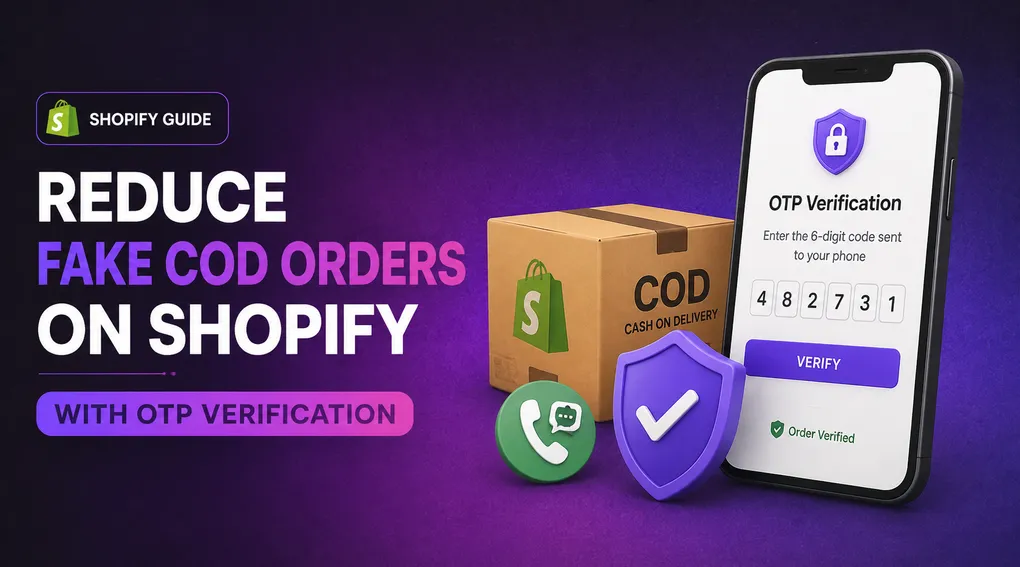
Cash on Delivery is one of the most popular payment methods for online stores in many markets. It gives customers the option to place an order without paying upfront, which can make buying more comfortable for first-time customers.
But COD comes with a challenge that prepaid orders usually don’t have: fake and unconfirmed orders.
A customer can submit an order with an incorrect phone number, a fake address, or no real intention of accepting the package. If the merchant ships that order, the result can be a failed delivery, return shipping cost, wasted packaging, and time spent handling an order that never becomes a successful sale.
This is where OTP verification can help.
By asking customers to verify their phone number before the order is processed, Shopify merchants can add an extra layer of protection to their COD workflow.
What Is a Fake COD Order?
A fake COD order is an order that looks legitimate but is unlikely to result in a successful delivery.
There are several ways this can happen.
A customer might enter an unreachable phone number, provide an incorrect address, place an order accidentally, or simply refuse to accept the package when the courier arrives.
Some merchants also experience repeated low-quality orders from the same phone number, IP address, or delivery location.
However, it’s important to remember that not every failed COD delivery is fraud.
A genuine customer can enter the wrong information, change their mind, miss a delivery call, or become unavailable when the courier arrives.
That’s why the goal shouldn’t be to label every failed order as fraudulent. Instead, merchants should add practical verification and fraud-prevention steps before shipping.
Why Fake COD Orders Can Hurt Your Business
A fake order can look harmless when it first appears in your Shopify admin.
For example, imagine receiving a COD order worth $50.
You prepare the product, package it, print the shipping label, and hand it to the courier. The package travels to the customer’s location, but the customer doesn’t answer the phone or refuses the delivery.
The order eventually comes back.
The original product may still be sellable, but you may have already spent money and time on:
- Forward delivery
- Return delivery
- Packaging
- Order processing
- Customer communication
- Courier handling
- Inventory tied up during delivery
If this happens occasionally, it may not be a major concern.
But when a store processes hundreds or thousands of COD orders, even a relatively small percentage of failed deliveries can become expensive.
That’s why fraud prevention should be part of the COD workflow rather than something merchants think about only after an order fails.
What Is OTP Verification?
OTP means One-Time Password.
It’s a temporary verification code sent to a customer’s phone number. The customer must enter the correct code to verify that they have access to the phone number they provided.
A typical COD verification process looks like this:
Customer submits COD order → OTP is sent → Customer enters OTP → Phone number is verified → Order continues
For example, a customer enters their phone number during the COD ordering process.
The store sends a verification code such as:
Your verification code is 482731
The customer enters the code.
If the code is correct, the phone number is verified.
This doesn’t prove that the customer will definitely accept the package, but it gives the merchant another useful signal before fulfillment.
How OTP Verification Helps Reduce Fake COD Orders
The biggest advantage of OTP verification is simple: it adds a verification step before the merchant commits to shipping the order.
Consider two customers.
Customer A enters a valid phone number, receives the OTP, and successfully verifies it.
Customer B enters an incorrect or unreachable phone number and cannot complete verification.
Without verification, both orders may initially look similar in the Shopify admin.
With OTP verification, the merchant has additional information that can help distinguish between them.
OTP can therefore help reduce some common problems, including:
- Incorrect phone numbers
- Unreachable numbers
- Accidental orders
- Low-quality orders
- Some types of prank or fake orders
It won’t eliminate every fake order. A real person can verify a phone number and still refuse a COD delivery later.
That’s why OTP works best as one layer of a broader COD fraud-prevention strategy.
SMS vs. WhatsApp OTP
The best verification channel depends on your customers and target market.
SMS OTP
SMS is straightforward and doesn’t require the customer to open another application.
The customer receives the code through their phone’s messaging service and enters it on the verification screen.
This makes SMS a familiar option for almost any mobile customer.
WhatsApp OTP
WhatsApp can be another convenient option in markets where customers frequently use it for communication.
Instead of receiving the verification code through SMS, the customer receives it through WhatsApp.
For merchants whose customers are already active on WhatsApp, this can make the verification process feel more familiar.
If your COD system supports both channels, you can provide customers with more flexibility.
The Ideal COD OTP Verification Flow
OTP verification works best when it happens before the merchant prepares the order for delivery.
Here’s a simple workflow.
1. Customer submits a COD order
The customer fills out your Cash on Delivery form and submits the required information.
2. The system sends an OTP
A temporary verification code is sent to the customer’s phone through SMS or WhatsApp.
3. Customer enters the code
The customer enters the OTP they received.
4. The phone number is verified
If the code is correct, the verification succeeds.
5. The order continues
The merchant can now process the order according to their normal fulfillment workflow.
If the customer cannot complete verification, the merchant can choose to review the order instead of immediately sending it to the courier.
This simple step can prevent some questionable orders from reaching the fulfillment stage.
OTP Alone Isn’t Enough
This is one of the most important things merchants should understand.
OTP verifies access to a phone number. It does not guarantee that the person will accept the parcel.
For example, someone can use their own phone number, successfully complete OTP verification, and still refuse the COD package later.
For stronger protection, merchants can combine OTP with other checks.
A more complete COD fraud-prevention strategy can include:
OTP verification + phone blocking + IP blocking + postal-code validation + order review
You can also monitor repeated orders, unusual quantities, suspicious delivery information, and previous failed deliveries.
The more signals you have, the easier it becomes to identify orders that deserve additional attention.
Use Other COD Fraud Controls Alongside OTP
Different fraud controls solve different problems.
Phone number blocking
If a phone number has repeatedly produced failed or suspicious orders, blocking future orders from that number can prevent the same problem from happening again.
IP blocking
Multiple suspicious orders coming from the same IP address can be another useful signal.
IP blocking can be particularly helpful when the same source repeatedly submits low-quality orders.
Postal-code validation
A valid postal code can help catch incomplete or inconsistent delivery information before an order reaches the courier.
Quantity limits
Unusually large quantities can sometimes indicate suspicious behavior.
For example, if a customer suddenly attempts to order a very large number of units through COD, you may want additional verification before fulfillment.
Order history
Your previous delivery data can also provide useful information.
If a phone number or address has repeatedly resulted in refused or returned COD orders, that history can help you decide how to handle future orders.
The important idea is not to depend on one rule.
Use multiple signals together.
Don’t Make OTP Verification Difficult
Fraud prevention shouldn’t come at the cost of a poor customer experience.
If the verification process takes too long or feels complicated, genuine customers may abandon the order.
A good OTP experience should be:
- Fast
- Easy to understand
- Mobile-friendly
- Clear about why verification is required
- Simple to resend
- Clear when an OTP is incorrect
- Free from unnecessary steps
Remember that many COD customers complete their orders from mobile devices.
The verification process should therefore feel like a small confirmation step, not a second checkout.
Should You Verify Every COD Order?
There isn’t one answer that works for every Shopify store.
Some merchants may want OTP verification for every COD order.
Others may prefer stricter verification for higher-risk orders, such as:
- First-time customers
- High-value orders
- Unusually large quantities
- Orders from previously problematic areas
- Orders associated with repeated failed deliveries
The right approach depends on your products, customers, delivery costs, and the number of failed COD orders your store receives.
If fake orders are already creating significant costs, verifying COD customers before fulfillment can be a practical place to start.
How Neo COD Form & Upsell Helps With COD Fraud Prevention
If your Shopify store relies heavily on Cash on Delivery, managing the order form, verification, fraud protection, and customer experience from separate systems can become complicated.
Neo COD Form & Upsell brings these parts of the COD workflow together.
With Neo, merchants can create a customizable Cash on Delivery form and add OTP verification through SMS or WhatsApp.
The app also includes additional tools that can help merchants manage suspicious orders, including:
- OTP verification
- Phone number blocking
- IP blocking
- Postal-code validation
- Quantity-based controls
- Custom COD forms
- Custom thank-you pages
- Upsells and downsells
- Quantity offers
- Multi-platform pixel tracking
- Abandoned-order features
This allows merchants to build a COD workflow where verification and fraud controls are part of the ordering process instead of being handled manually after every order.
A Simple COD Fraud-Prevention Strategy
If you’re currently dealing with fake COD orders, you don’t need to introduce every possible fraud-control method at once.
Start with a simple process:
Step 1: Add OTP verification
Verify the customer’s phone number before processing the COD order.
Step 2: Block repeat offenders
If the same phone number or IP repeatedly generates suspicious orders, consider blocking it.
Step 3: Validate delivery information
Check the customer’s phone number, postal code, city, district, and address.
Step 4: Review unusual orders
Pay additional attention to high-value orders, unusually large quantities, or repeated orders from the same source.
Step 5: Track failed deliveries
Look at which orders are refused, cancelled, returned, or otherwise unsuccessful.
Step 6: Improve your rules over time
Use your own order data to identify patterns and adjust your fraud-prevention process.
This is generally more effective than trying to find one tool that claims to detect every fake order automatically.
Frequently Asked Questions
Does OTP completely prevent fake COD orders?
No.
OTP verifies that the customer can access the phone number they provided. It doesn’t guarantee that the customer will accept the parcel.
For stronger protection, combine OTP with other fraud controls and order-review rules.
Can OTP reduce fake COD orders?
Yes, it can help reduce some types of fake or low-quality orders, particularly those involving incorrect or unreachable phone numbers.
However, the actual impact depends on your customers, market, products, and overall fraud-prevention strategy.
Is SMS OTP better than WhatsApp OTP?
Neither is universally better.
SMS is widely familiar, while WhatsApp can be convenient in markets where customers frequently use it.
If possible, supporting both gives merchants more flexibility.
Should I require OTP for every COD order?
It depends on your business.
If fake COD orders are a significant problem, verifying every COD order may be worthwhile. If your failed-order rate is already low, you may prefer a more selective verification strategy.
What else can I use with OTP verification?
You can combine OTP with phone blocking, IP blocking, postal-code validation, quantity rules, order history, and manual review.
Using multiple signals provides stronger protection than relying on OTP alone.
Final Thoughts
Fake COD orders can quietly eat into the margins of a Shopify store.
The product may eventually return to your inventory, but the shipping costs, return costs, packaging, support time, and operational effort are still real.
OTP verification provides a simple way to add another checkpoint before a COD order moves toward fulfillment.
It doesn’t guarantee that every verified customer will accept their package, and it shouldn’t be treated as a complete fraud-detection system. But when combined with phone blocking, IP controls, postal-code validation, quantity rules, and order review, it can become an important part of a safer COD workflow.
If you want to add OTP verification while also managing your Cash on Delivery form and other COD tools from one Shopify app, you can try Neo COD Form & Upsell.
A good COD strategy isn’t about making the ordering process harder for everyone. It’s about adding the right checks at the right time so genuine customers can order easily while questionable orders receive the attention they deserve.