COD vs Prepaid for Indian Shopify Stores: Which Should You Offer?
COD drives most Indian ecommerce sales. Here is how to offer cash on delivery profitably alongside prepaid, with the right verification, upsells and tracking.
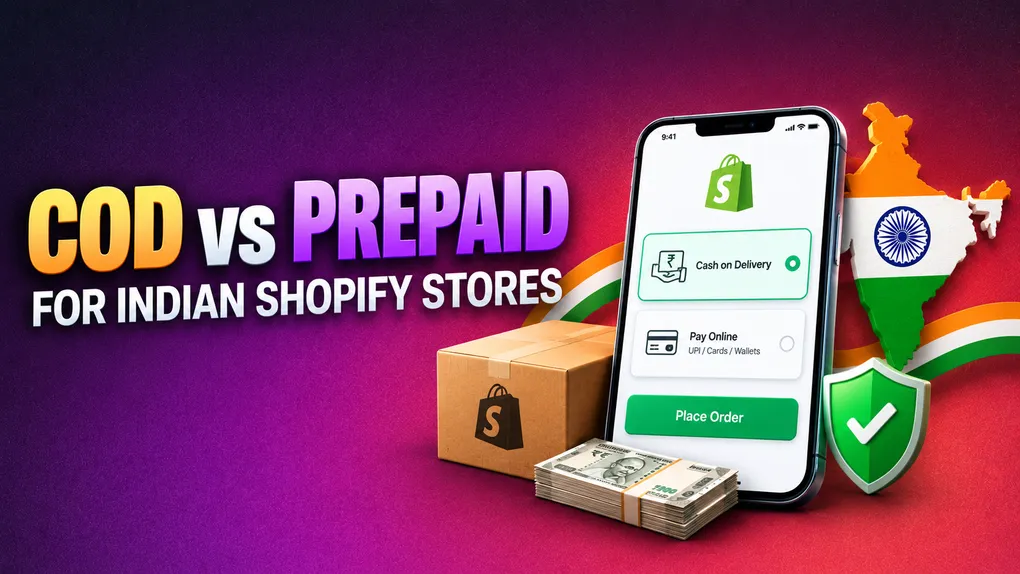
Ask ten Indian D2C founders about cash on delivery, and you will hear the same complaint. RTO is killing them. Remittance is slow. Fake orders are everywhere.
Then ask them what happens when they switch COD off for a week.
Sales fall off a cliff.
That reaction tells you everything. COD is not a problem to be solved. It is the single biggest reason Indian ecommerce reached the scale it did, and for most stores it is still where the majority of revenue comes from. The founders who struggle are not the ones offering COD. They are the ones offering it without any system behind it.
So let’s answer the COD vs prepaid question honestly, from the position most Indian stores are actually in.
The Short Answer
Offer COD as your primary option. Offer prepaid alongside it, made attractive enough that a good share of customers pick it on their own.
Not the other way around.
In India, prepaid-only is a strategy for brands that already have national recognition and a customer base that trusts them by default. Everyone else is buying cold traffic from Meta, Google and Instagram, and cold traffic in India buys on COD.
The real work is not choosing between the two. It is running COD properly so it makes money.
Why COD Is Still the Backbone of Indian Ecommerce
Cash on delivery is the default for most Indian shoppers, and it is not close. According to ET Prime Research, 60 to 65 percent of all ecommerce orders in India are placed via COD, and in Tier 2 and Tier 3 cities that number climbs even higher. In some smaller markets, COD can account for 70 to 80 percent of orders.
That is not a legacy habit waiting to die out. It is where the growth is.
The fastest-growing slice of Indian ecommerce right now is Tier 2, Tier 3 and rural buyers coming online for the first time. Those are exactly the customers who buy on COD. A store that pushes prepaid too hard is not optimising its margins. It is opting out of the biggest expansion happening in the market.
And here is the part people miss. Digital payments in India are enormous. UPI regularly crosses 24 billion transactions worth close to ₹30 lakh crore in a single month, growing over 20 percent year on year, and it handles roughly 80 percent of retail digital payments by volume in the country.
So the same customer who pays for chai with a UPI scan still picks COD on your product page.
That is not a payments infrastructure problem. It is a trust gap between that customer and your brand specifically. COD is the bridge across it. Remove the bridge and you do not get a prepaid order. You get no order.
What COD Actually Does for Your Store
It converts cold traffic. A first-time visitor from an ad has no reason to believe you will ship. COD removes their entire perceived risk, and conversion rates on cold audiences are meaningfully higher because of it.
It opens up the whole country. Metro-only prepaid stores are competing for a small, expensive audience. COD lets you sell profitably into markets where your competitors are not bothering to advertise.
It lowers your customer acquisition barrier. No card, no wallet, no failed bank app. Anyone with a phone number can order.
It builds your first hundred reviews. New stores need social proof more than they need perfect margins. COD gets you volume fast, and volume gets you reviews, UGC and repeat buyers.
It works brilliantly for impulse products. Under ₹999, single-product ad campaigns, one-page funnels. COD is what makes that entire playbook viable in India.
The stores doing seven and eight figures on COD in India are not lucky. They just built the operational layer around it.
The Costs, and Why Each One Is Fixable
COD does carry costs. The important thing is that almost every one of them responds to a specific fix. This is not an unavoidable tax on your business.
RTO
COD orders in India see a 25 to 30 percent RTO rate, while prepaid sits at 2 to 3 percent. That gap is real, and a RedSeer estimate puts the annual loss to Indian ecommerce from high RTO and failed deliveries at over ₹20,000 crore.
But that 25 to 30 percent is the unmanaged average. It includes stores with no phone verification, no address validation, no pin code filtering and no order confirmation. Stores that add those layers routinely run COD RTO in the low teens. Some get under 10.
The fix: OTP verification, postal code validation, IP blocking, and disabling COD on your worst-performing pin codes.
Slower cash cycle
Sellers typically wait seven days or more for COD remittance. When you are funding ads and restocking at the same time, that delay stings.
The fix: partial payments. Collect a small deposit upfront, take the rest on delivery. You get working capital on day one and the customer still keeps the protection they wanted.
Lower order value
COD orders tend to be smaller, which makes the shipping cost hurt more as a percentage.
The fix: upsells, downsells, one-tick add-ons and quantity discounts on the order form itself. Lifting AOV by 20 percent changes the profitability of every single COD shipment you send.
Fake and junk orders
Wrong numbers, joke addresses, competitors, kids ordering without a parent knowing.
The fix: OTP. This one filter removes most of it before the parcel ever gets packed.
Messy ad data
If your pixel reports 100 purchases and a chunk of them RTO, Meta optimises toward people who never actually pay.
The fix: accurate server-side event tracking on your COD form, so your campaigns learn from real delivered orders instead of noise.
Here is the math one operator ran. A brand shipping 8,000 orders a month at 55 percent COD with a 28 percent COD RTO rate ends up with roughly 1,230 failed orders monthly. At ₹220 average RTO cost, that is about ₹2.7 lakh a month, or ₹32 lakh a year.
Now run it again at 14 percent RTO instead of 28. The same store saves roughly ₹16 lakh a year without touching its COD volume at all.
That is the actual opportunity. Not switching off COD. Running it better.
Where Prepaid Fits In
Prepaid is not the enemy, and you should absolutely offer it. It gives you money on day one, near-zero RTO, cleaner attribution and lighter support load.
What prepaid cannot do is convert the customer who has not decided to trust you yet. That is why it works best as a well-incentivised second option rather than the only door into your store.
Give people a reason to choose it and a healthy percentage will:
- Free shipping on prepaid orders only
- A flat ₹50 to ₹100 off for paying upfront
- An extra item or a small gift on prepaid
- A prepaid-only bundle price
Frame it as a reward, never a penalty. Charging heavy COD fees pushes customers to abandon. Discounting prepaid pulls them in voluntarily, and the math works because you are saving ₹150 to ₹300 per order in avoided RTO and reverse logistics. If you do add a COD fee, keep it in the ₹10 to ₹30 range and call it a handling fee.
COD vs Prepaid: Side by Side
| What matters | COD | Prepaid |
|---|---|---|
| Share of Indian orders | 60 to 65 percent, higher in Tier 2 and 3 | Roughly a third, concentrated in metros |
| Conversion on cold traffic | Strong | Weaker until brand is known |
| Reach across India | Nationwide, including new online buyers | Skews metro and repeat customers |
| RTO rate | 25 to 30 percent unmanaged, low teens when managed | 2 to 3 percent |
| When you get paid | After delivery, plus remittance cycle | Immediately |
| Average order value | Lower, but liftable with upsells | Higher |
| Best used for | Acquisition, new markets, impulse products | Repeat buyers, high-value carts |
Read that table as two tools, not two teams. COD wins you the customer. Prepaid is what that customer graduates to on their second and third order.
What a Healthy Payment Mix Looks Like
There is no universal split, but there are sensible patterns. New businesses in emerging markets often sit around 60:40 in favour of COD. Mid-sized brands optimising for growth land near 50:50. Established brands with strong recall get to 30:70.
Treat that as a natural progression, not a scoreboard. A store at 70 percent COD with a 12 percent RTO rate is in far better shape than a store at 40 percent COD with 30 percent RTO.
By stage:
Just launched, under 300 orders a month. COD wide open. You need volume and proof. Add OTP from day one, because junk orders hurt most when the numbers are small.
Growing, 300 to 3,000 orders a month. Keep COD as the primary path, but start layering in prepaid incentives, pin code rules and RTO tracking by product and region.
Scaled, 3,000 plus. You have brand recall and real data. COD becomes something you deploy deliberately, with deposits on high-value carts and full flexibility on everything else.
Also vary it by cart value. A ₹399 impulse buy carries COD easily. A ₹4,999 order is worth asking for a deposit on.
The Playbook: Make COD Profitable
1. Verify every phone number with OTP
Highest-leverage change available to a COD store in India. It kills fake numbers and mistyped digits on the spot, and it hands you a verified contact for follow-ups later.
2. Use a one-page COD order form
Standard Shopify checkout is built for card payments and multiple steps. On mobile, in India, that is friction. A single form with name, phone and address converts noticeably better, and it gives you somewhere to put your verification and your offers.
3. Lift AOV on the same order
This is the fastest route to COD profitability and the most ignored. Pre-purchase upsells, one-tick add-ons, downsells for people who decline, quantity discounts that push two units instead of one. Every rupee added to a COD order is a rupee that does not need a second shipment to earn.
4. Filter your worst pin codes
Pull three months of data, sort by RTO, and disable COD on the worst offenders. Those customers can still buy prepaid, so nothing is fully lost.
5. Collect a partial payment on big carts
A ₹100 or 20 percent deposit changes customer behaviour completely. Refusal rates drop hard because they now have something at stake, and you get cash upfront.
6. Confirm before dispatch
A WhatsApp or SMS message right after the order, asking them to confirm, with a small discount if they want to switch to prepaid. Brands report 15 to 25 percent conversion on this. A checkout discount, a well-timed message, a COD eligibility filter and reliable delivery together can shift 30 to 40 percent of COD volume within about two months.
7. Recover abandoned forms
Someone who typed their phone number and stopped is your warmest possible lead. Most stores never follow up.
8. Fix your pixel
If a chunk of your orders come through a custom COD form, there is a strong chance your purchase events are firing wrong or not at all. Bad data means your ads chase the wrong people, and no amount of creative testing fixes that.
9. Ship faster
The longer a COD parcel takes, the more time the customer has to change their mind. Faster delivery lowers RTO on its own.
Putting the Whole System in One Place
Look at that list again. OTP, a proper form, upsells, pin code rules, partial payments, confirmation messaging, abandoned form recovery, accurate tracking. That is eight things, and stitching them together from separate tools gets expensive and fragile fast.
Neo COD Form & Upsell is built to handle the whole chain in a single app:
- A 1-click COD order form with drag-and-drop fields, your own colours and fonts, custom thank-you page and a full-screen mobile mode.
- OTP verification, IP blocking and postal code validation so fake orders never reach your courier.
- Partial payments to collect a deposit before shipping and protect high-value carts.
- Upsells, downsells, one-tick offers and quantity discounts to raise AOV on the same order.
- Abandoned cart recovery for the people who started the form and dropped off.
- Accurate pixel tracking for Meta, GA4, Google Ads, TikTok, Snapchat, Pinterest and X.
- A built-in messaging system for order confirmation and prepaid switch offers.
There is a free plan covering 100 orders a month, so you can run the full setup on your own traffic before paying for anything. Details are on the Neo COD Form & Upsell listing.
The Numbers to Track
Revenue alone hides everything. Watch these instead:
- Delivered order percentage. The only number that becomes cash.
- COD RTO rate. Above 25 percent means your verification layer is missing or weak. Low teens is achievable.
- Average order value on COD specifically. This is what your upsells should be moving.
- Cost per delivered order. Ad spend divided by delivered orders, not total orders. Most stores are 30 to 40 percent off on this.
- RTO by pin code, product and campaign. All three will surprise you.
- Prepaid share, trending. Not a target to force, just a signal that trust is building.
A Simple 30 Day Plan
Week 1. Switch to a proper COD form and turn on OTP verification. Pull three months of RTO data by pin code and product.
Week 2. Add upsells and quantity offers to the form. Measure the AOV change.
Week 3. Block COD on your worst pin codes. Set a cart value above which you ask for a deposit.
Week 4. Turn on confirmation messaging before dispatch, with a prepaid switch offer inside it.
Then compare delivered orders and cost per delivered order against week 1. Do not run all four at once or you will not know what worked.
Frequently Asked Questions
Should Indian Shopify stores offer COD? For almost all of them, yes. COD accounts for 60 to 65 percent of Indian ecommerce orders and even more outside metros. Removing it cuts conversions far harder than it improves margins.
Is COD profitable? It is, once you add verification, upsells and pin code rules. Unmanaged COD with a 28 percent RTO rate loses money. Managed COD in the low teens with a lifted AOV is very profitable.
What is a good COD to prepaid ratio in India? New stores commonly sit near 60:40 in favour of COD. Established brands drift toward 30:70. Both can work. Your RTO rate matters more than your ratio.
Does OTP verification hurt conversions? Placed orders may dip slightly. Delivered orders go up, because the orders it filters are mostly the ones that would have come back anyway.
Should I charge a COD fee? A small handling fee is fine. A large one reads as a penalty. Rewarding prepaid with a discount or free shipping usually performs better than taxing COD.
Can I run COD ads and still get clean Facebook data? Yes, with proper server-side pixel tracking on your order form. Without it your campaigns optimise toward the wrong audience.
Final Word
COD built Indian ecommerce, and it is still how most of your customers want to buy. Treating it as a liability means walking away from the majority of your addressable market.
The stores that scale in India do the opposite. They lean into COD and build the system that makes it work: verify the number, filter the bad addresses, raise the order value, take a deposit when the cart is big, confirm before dispatch, and keep the tracking honest.
Do that and your delivered order rate climbs, your cost per delivered order drops, and prepaid grows quietly on its own as customers start trusting you.
If you want that entire stack in one app, Neo COD Form & Upsell covers the form, OTP, fraud controls, partial payments, upsells and pixel tracking together. Start on the free plan, run it for a month, and compare your delivered order numbers before and after.
That comparison will tell you everything.