COD vs Online Payment in Algeria: Which Is Better for E-commerce in 2026?
About 90% of Algerian online orders use COD. Compare COD vs online payments, RTO rates, and tips to run Shopify COD profitably.
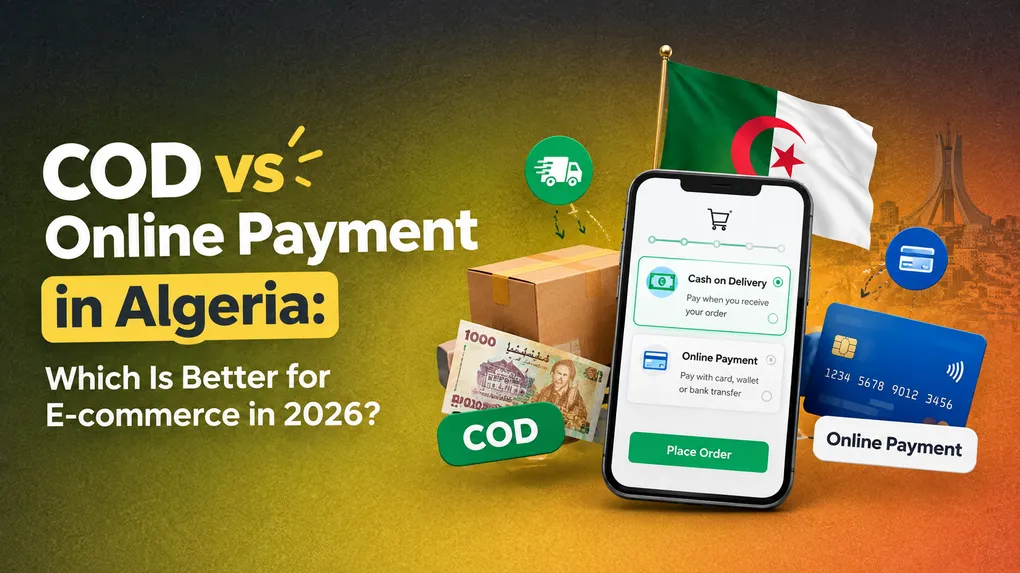
If you sell online in Algeria, or you are thinking about it, you have probably already had this argument with someone. Maybe with your business partner, maybe with a Facebook group, maybe with yourself at 2 in the morning while looking at your return rate.
One side says cash on delivery is a headache. Refused parcels, wasted shipping money, phone numbers that never answer. The other side says try removing COD from your store and watch your sales disappear overnight.
Both sides are right about something. But when you look at how Algerians actually buy things online, the answer is not really a fifty fifty debate. Let me walk you through the numbers first, then the practical part.
The short answer
COD is still the right primary payment method for almost every store selling to Algerian customers in 2026. Online payment is growing fast, and you should absolutely offer it, but it works best as a second option or as a deposit, not as your only checkout.
The stores that struggle are not the ones using COD. They are the ones using COD badly, with no confirmation process, no phone validation, and no way to filter out fake orders before the parcel leaves the warehouse.
What Algerian online shopping actually looks like right now
Some real figures, because opinions are cheap.
UNCTAD’s eTrade Readiness Assessment for Algeria found that roughly 90 percent of online transactions in the country are paid cash on delivery. Local operators and delivery companies often put the number closer to 95 percent. Either way, the picture is the same. Cash is not a minority preference in Algeria. It is the default.
That same assessment noted something else worth paying attention to. The number of registered e-commerce businesses in Algeria has grown at an average of about 92 percent per year since 2020. Meanwhile business to consumer e-commerce was estimated at only around 0.8 percent of GDP in 2023. Translation: a lot of new sellers are entering a market that is still very early. There is room.
On the payment side, things are genuinely moving. Algeria passed 22 million interbank payment cards in circulation by March 2026, and close to 18 million of those are Edahabia cards from Algérie Poste. Electronic payment terminals jumped from around 68,000 at the end of 2024 to more than 104,000 by early 2026. Total electronic payments reached 939 billion dinars in 2025, up 46 percent in a single year according to GIE Monétique.
And here is the number that gets people excited: internet payments specifically hit about 145 billion dinars across roughly 27 million transactions in 2025, a jump of around 179 percent year on year.
That is real growth. So why is COD still winning?
Why COD still dominates in Algeria
1. Having a card is not the same as using it online
Almost 18 million of those 22 million cards are Edahabia, which most people primarily use for withdrawing their salary or pension at the post office. Owning the card and being comfortable typing its number into a store you found through an Instagram ad are two completely different things.
2. Trust is the actual product you are selling
Algerian buyers have been burned. Wrong sizes, fake brands, products that never arrived, sellers who disappeared. When a customer can inspect the parcel and hand over the money at the door, you have removed the single biggest reason people abandon a purchase. COD is not just a payment method here. It is a trust guarantee.
3. Most sales still start on social media
A huge share of Algerian e-commerce happens on Facebook, Instagram and TikTok. Someone sees a video, taps a link, and wants to order in fifteen seconds. Asking that person to find their card, remember a PIN, and complete a 3D Secure step is asking them to lose interest. A short form with a name, a phone number and a wilaya converts far better.
4. The law is on your side
Law 18-05 of 10 May 2018, which organises e-commerce in Algeria, explicitly allows electronic transactions to be paid remotely or at the time the product is delivered. COD is not a workaround. It is a recognised payment method.
5. The delivery network is built for cash
Yalidine, ZR Express, Maystro, Noest and the Ecotrack network all handle COD collection as a core service, with home delivery and stop desk options across the wilayas. Some pay out daily, others weekly. The whole logistics ecosystem in Algeria was built around collecting cash at the door. Prepaid does not get you any logistical advantage locally.
The honest downside of COD
I am not going to pretend COD is free money. It has one very expensive problem: returned parcels, what everyone calls RTO.
Across the MENA region, COD orders are returned at roughly 19 percent compared to around 8 percent for prepaid orders. In Algeria, sellers who run their operations well usually sit somewhere between 8 and 15 percent RTO. Once you cross 30 percent, you are working for your courier, not for yourself.
The cost is brutal because you pay twice. A refused parcel in the north typically costs somewhere between 600 and 1,000 dinars once you count the outbound leg, the return leg, packaging and your time. In the Sahara or for bulky items it can climb well past 2,000 dinars. You get zero revenue for that.
Run the math on 100 shipped parcels with a net margin of around 1,200 dinars per delivered order:
- At 10 percent RTO: 90 delivered, about 108,000 dinars margin, minus roughly 8,000 in return losses.
- At 25 percent RTO: 75 delivered, about 90,000 dinars margin, minus roughly 20,000 in return losses.
Fifteen points of RTO just cost you around 30,000 dinars on the same ad spend. That is why RTO control, not payment method, is the real conversation.
The second downside is cash flow. Your money sits with the courier until the payout cycle clears, anywhere from a few days to two weeks depending on who you ship with. If you are scaling ad spend, that gap matters.
Where online payment genuinely helps
Online payment in Algeria is not a fantasy. Chargily Pay lets Algerian merchants accept CIB and Edahabia cards with a free API and ready made plugins, and it is the option most Shopify sellers look at first. BaridiMob has become a normal way for younger buyers to move money, with its daily limit raised to 200,000 dinars back in 2023.
Prepaid makes real sense in a few specific cases:
- High ticket items. If a parcel is worth 40,000 dinars, a single refusal wipes out several successful sales. Ask for prepayment or at least a deposit.
- Repeat customers. Someone who already bought from you twice will happily pay in advance, especially with a small discount.
- Custom or made to order products. You should never produce something specific to one customer on a COD promise.
- Buyers who have already refused a parcel. Keep a list. Offer them prepaid only.
- Digital products and services. Obvious, but worth saying.
The mistake is forcing prepaid on cold traffic. If someone just discovered your brand from a video, removing COD does not make them pay by card. It makes them close the tab.
COD vs online payment in Algeria: side by side
| Factor | Cash on Delivery | Online Payment (CIB / Edahabia) |
|---|---|---|
| Customer trust | Very high, buyer pays after seeing the parcel | Lower for new or unknown brands |
| Conversion rate on cold traffic | Strong, especially from social ads | Noticeably weaker |
| Reach across the country | Works everywhere a courier goes | Limited to comfortable card users |
| Return and RTO risk | High if not managed properly | Very low |
| Cash flow speed | Delayed by courier payout cycles | Fast, money lands upfront |
| Fake and prank orders | A real problem without verification | Almost none |
| Setup effort | Form plus courier account | Gateway approval and integration |
| Best used for | Most products, most traffic, most stores | High ticket, repeat buyers, deposits |
The setup that actually works in Algeria
The winning combination is not COD or online payment. It is COD first, with prepaid available as a smart option and a deposit system for risky orders.
Here is what that looks like in practice.
Replace the standard checkout with a short COD form
Shopify’s default checkout was designed for card payments in North America. It asks for an email, a full address, a postal code, and it takes several screens. For an Algerian buyer paying cash, most of that is noise.
A one page COD form on the product page, with name, phone, wilaya and commune, will convert dramatically better. This is exactly what Neo COD Form & Upsell is built for. You drag the fields you want, match the colours to your brand, and the customer orders in one click without touching Shopify checkout.
Confirm the order before you ship it
This is the single highest impact thing you can do. Most refused parcels in Algeria trace back to a wrong number, a joke order, or a buyer who changed their mind ten minutes later. A quick call or message before the parcel leaves your hands catches all three. Sellers who build a proper confirmation step into their workflow typically pull five to ten points off their RTO, which is more than any other single change on this list.
A clean phone field on the form helps here too. If the number is malformed at the point of order, you already know something is wrong.
Block the traffic that is costing you money
IP blocking, country filters and postal code validation are unglamorous features that quietly save real dinars. If the same address refuses three parcels, they should not be able to order a fourth on COD.
Take a deposit on risky or expensive orders
Partial payment is the most underrated tool in the Algerian market. Asking for a small deposit on orders above 15,000 or 20,000 dinars filters out non serious buyers without killing your volume the way full prepaid would. You lose a few orders and keep far more margin. Neo COD Form & Upsell supports partial payments directly on the form, so you can set that rule and forget about it.
Raise the value of the orders you do ship
Every parcel you ship carries the same delivery cost whether it holds one item or three. That is the core economics of COD in Algeria. Quantity offers, one tick upsells, pre purchase and post purchase offers and downsells all push your average order value up without a single extra dinar of ad spend or shipping. A 3,500 dinar order and a 6,000 dinar order cost you exactly the same to deliver.
Fix your pixel tracking
Here is a problem specific to COD stores. When you bypass Shopify checkout with a custom form, your Meta, TikTok and GA4 events often break. Your ads start optimising against bad data, your cost per purchase looks wrong, and you make budget decisions blind. Server side event tracking across Meta, GA4, Google Ads, TikTok, Snapchat, Pinterest and X keeps your reporting accurate. If you are spending money on ads in Algeria, this is not optional.
Follow up on abandoned and unconfirmed orders
Someone who filled in their phone number and stopped is a warm lead, not a lost one. A quick message recovers a meaningful share of those. Built in messaging and abandoned order recovery turn a leaking bucket into revenue.
Common mistakes Algerian sellers make
Removing COD to fix RTO. This treats the symptom and kills the business. Fix confirmation and filtering instead.
Shipping every order immediately. Speed is good, but shipping an unconfirmed 8,000 dinar parcel to a number nobody answers is just donating to your courier.
Using one courier for the whole country. Coverage and reliability vary by wilaya. Test two, compare RTO by region, and route accordingly.
Ignoring stop desk. Customers who choose stop desk pick up their parcels more reliably than home delivery in many wilayas. Offer both and let them choose.
Not tracking RTO by product. One bad product can be dragging down your entire return rate. Look at it per SKU, per wilaya, per courier.
Frequently asked questions
Is cash on delivery legal for e-commerce in Algeria? Yes. Law 18-05 of 2018 on e-commerce explicitly allows payment either remotely or on delivery of the product, using the payment methods permitted by legislation.
What percentage of Algerian online orders are COD? UNCTAD puts it at around 90 percent of online transactions. Industry groups and delivery operators often cite figures closer to 95 percent.
Can I accept card payments on Shopify in Algeria? Local card payment through CIB and Edahabia is usually handled by a local gateway such as Chargily Pay, which publishes a free API and plugins. Check its current Shopify integration status before you commit, since local gateway support changes.
What is a normal RTO rate in Algeria? Well run stores generally land between 8 and 15 percent. Above 25 to 30 percent, your unit economics stop working.
Should I charge a COD fee? It depends on your margin and your niche. Many Algerian sellers build the delivery cost into the product price instead, because a visible extra fee at the last step causes abandonment. If you do charge one, show it clearly on the form from the start.
Does offering both COD and online payment confuse customers? Not if COD is the obvious default and prepaid sits beside it as a choice, sometimes with a small discount attached. Problems only start when you make prepaid the only option.
Final verdict
For Algeria, COD wins. Not because online payment is bad, but because payment method choice is decided by the customer, not by the merchant, and Algerian customers have made their choice very clearly.
The seller who grows in this market is not the one who fights COD. It is the one who takes COD seriously as an operation: a short form instead of a long checkout, confirmed orders before dispatch, blocked repeat refusers, deposits on big orders, upsells to raise the value of each parcel, and pixel data clean enough to actually trust.
Get those right and COD stops being the risky option. It becomes your advantage over every competitor who is still pushing a card only checkout at a market that does not want one.
If you are running a Shopify store for Algerian customers and you want that whole stack in one place, Neo COD Form & Upsell covers the form, fraud controls, partial payments, upsells, abandoned order recovery and multi platform pixel tracking, with a free plan to start on.